The Impact of Vaping on Gum Tissue and Oral Health
Patients who have switched from cigarettes to vaping often mention it almost in passing, as something that no longer needs discussing. It does need discussing — not because vaping is equivalent to smoking, but because the effects on gum tissue are different enough that assuming they are absent leads to problems being missed.
The evidence base is still developing. Cigarettes have been studied for decades; e-cigarettes in their current form have not. What follows reflects what is reasonably established and is explicit about where uncertainty remains.
What actually reaches the gums
E-cigarette aerosol is not water vapour, despite the everyday shorthand. It is a heated mixture of propylene glycol and vegetable glycerine carrying nicotine, flavouring compounds and trace by-products of the heating process.
Because inhalation draws that aerosol across the whole mouth, gum tissue receives the full exposure — the tissue at the gum margin, in the interdental spaces and around any restorations or implants.
Three components matter for the gums specifically.
Nicotine is a vasoconstrictor. It narrows the small blood vessels supplying the gingival tissues, reducing local blood flow.
Propylene glycol is hygroscopic — it attracts and holds water. In the mouth this draws moisture from the oral tissues and from the saliva film.
Flavouring compounds vary enormously between products, and laboratory work suggests some are more irritating to gingival cells than others. The clinical significance in real-world use is not yet settled.
How nicotine changes the gum picture
The vasoconstriction effect has two consequences, and the second is the one that causes trouble.
Reduced blood supply impairs the tissue's defence and repair. Gum tissue depends on good perfusion to deliver immune cells to the sulcus and to heal after irritation or treatment. When flow is reduced, the response to plaque is blunted and healing after gum treatment tends to be slower.
Reduced blood supply also suppresses bleeding. This is the critical point. Bleeding when brushing is the main early warning sign of gum inflammation, and the one most patients act on. In a nicotine user, gums that are genuinely inflamed may bleed little or not at all.
The result is that disease can progress further before it becomes obvious. This is a well-recognised pattern in smokers, and the same mechanism applies wherever nicotine is delivered. Our articles on bleeding gums when brushing and the difference between gingivitis and periodontitis explain what that early sign normally indicates.
It is worth noting that this masking effect is a property of nicotine rather than of smoke, which is why nicotine-free products are a partially different proposition.
Dry mouth and why it matters
Saliva does more than most people credit it with. It buffers acid, clears food debris and bacteria, delivers antimicrobial proteins, and keeps the mucosa lubricated and intact.
Propylene glycol's water-attracting behaviour reduces the salivary film, and many vapers describe a persistently dry mouth or a raw sensation in the throat. Frequent use through the day compounds it, because the tissue is given little opportunity to recover.
The downstream effects are predictable: more plaque accumulation because less is being washed away, less acid buffering and therefore higher decay risk, more susceptibility to fungal overgrowth, and mucosa that is more easily irritated.
Dry mouth is also frequently treated as a nuisance rather than a clinical finding. It is worth mentioning at appointments, because it changes how risk is assessed and what preventive measures are appropriate.
How vaping compares with smoking
This is the question patients most want answered, and it deserves a careful response.
Vaping avoids combustion, and with it the tar, carbon monoxide and the large family of combustion-derived toxicants that make cigarettes so damaging to periodontal tissue. UK public health guidance treats switching completely from smoking to vaping as a harm-reduction step for adults who would otherwise continue to smoke.
That is not the same as saying vaping is neutral for gums. The nicotine-driven vasoconstriction and the drying effect are both present, and both are relevant to gum health. And dual use — vaping while continuing to smoke — retains the full risk profile of smoking.
The honest position is that vaping appears less harmful to gum tissue than smoking, that it does not appear to be harmless, and that the long-term data needed to be more precise does not yet exist.
Our article on implants in smokers covers the periodontal and implant implications of tobacco, much of which is relevant by analogy.
What vapers may notice
The changes are often subtle, which is part of the difficulty.
• A persistently dry mouth, particularly on waking
• Gum tissue that looks paler or more fibrous than expected, rather than the healthy pink of well-perfused tissue
• Bad breath that does not respond to improved cleaning
• Receding gum margins, or teeth that look longer than they did
• Increased sensitivity where the root surface has become exposed
• Slower healing after extractions, gum treatment or surgery
• Little or no bleeding despite visible inflammation — the finding that should prompt most concern rather than least
The last point bears repeating. Absence of bleeding in a nicotine user is not evidence of health.
Our articles on receding gums and what gums reveal about overall health cover the wider picture.
Staining and appearance
Vaping does not produce the tar-based brown staining characteristic of cigarettes, and this is one of the genuine differences patients notice.
It does not follow that vaping leaves teeth unaffected. Reduced saliva means less natural clearance of chromogens from tea, coffee and red wine, so extrinsic staining from other sources tends to accumulate more readily. Some flavoured liquids contain colourants of their own. And any staining removal is only ever addressing the surface, not the underlying tissue changes.
Protecting your gums if you vape
If you vape and are not planning to stop, several measures are worth adopting.
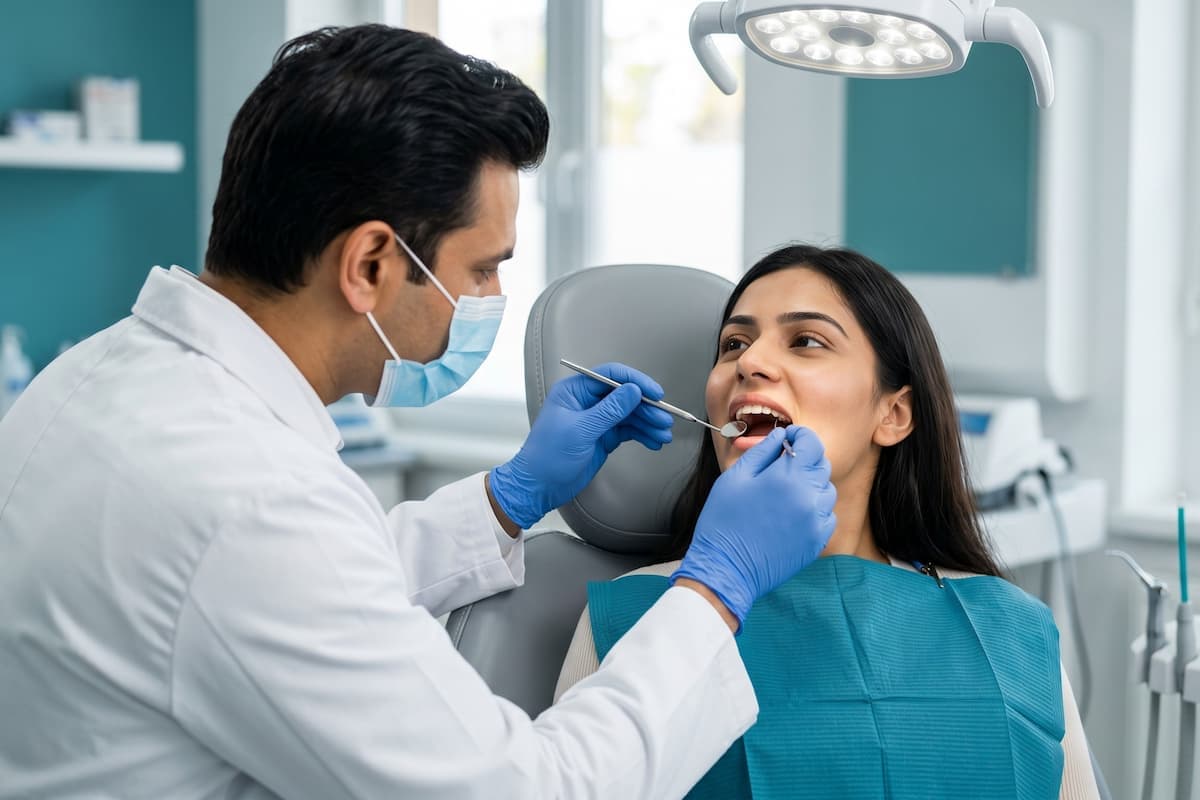
Tell your dental team. This is the most useful single step. It changes how your gums are assessed — particularly the weight given to the absence of bleeding — and may shorten your recall interval.
Accept a shorter recall. Because the usual early warning sign is unreliable, more frequent professional assessment with probing measurements is how disease is caught early instead.
Address the dryness deliberately. Water through the day, sugar-free gum to stimulate flow, and where dryness is marked, saliva substitutes available from a pharmacy.
Clean interdentally every day. Where saliva is doing less clearing, mechanical cleaning has to do more. Our article on how to floss properly covers technique.
Use fluoride toothpaste and spit rather than rinse. Dry mouth raises decay risk, and leaving the fluoride in place after brushing is a simple way of offsetting some of it.
Consider reducing nicotine strength. Since the vasoconstriction is nicotine-driven, lower-strength liquid reduces that particular effect, though it does not address the drying.
If you are vaping as a route away from smoking, consider where the route ends. NHS stop-smoking services support people through the final step as well as the first.
Vaping around implants and gum treatment
Two situations warrant specific mention.
Dental implants. Osseointegration depends on an adequate blood supply to healing bone, and peri-implant tissues have a less robust defence than natural teeth. Nicotine exposure is a recognised risk factor for implant complications, and it is reasonable to expect vaping to carry some of that risk. Our articles on peri-implantitis warning signs and biological changes after implant placement explain what healing depends on.
After gum disease treatment. Reattachment and reduction in pocket depth after periodontal therapy both depend on good tissue perfusion. Nicotine use is associated with poorer response, and this is worth factoring into expectations before treatment begins. Our article on how long gum disease treatment takes sets out the usual timeline.
Key points
• Vaping delivers nicotine, propylene glycol and flavourings directly across gum tissue
• Nicotine constricts gingival blood vessels, impairing defence and healing
• The same mechanism suppresses bleeding, masking the main early sign of gum disease
• Propylene glycol contributes to dry mouth, which raises both plaque and decay risk
• Vaping appears less damaging to gums than smoking, but the evidence does not support treating it as harmless
• Telling your dental team you vape changes how your gums are assessed, and is the most useful step you can take
Frequently Asked Questions
Can vaping cause gum disease?
Gum disease is driven by plaque bacteria, so vaping does not cause it directly. What nicotine does is reduce the blood supply to gum tissue, which impairs the local defence and healing response and makes inflammation harder to detect. The current evidence suggests vaping is a contributing risk factor rather than a primary cause.
Does vaping stain teeth like smoking?
Not in the same way — there is no tar, so the characteristic brown smoking stain does not develop. However, reduced saliva means less natural clearance of staining from tea, coffee and wine, so discolouration from other sources may accumulate more readily.
Is nicotine-free vaping safer for gums?
It removes the vasoconstriction, which is the mechanism behind both impaired healing and masked bleeding, so that is a meaningful difference. The propylene glycol drying effect and the flavouring exposure remain. Nicotine-free is likely better for gum tissue, but not the same as no exposure.
Should I tell my dentist that I vape?
Yes, and it is worth being specific about frequency and nicotine strength. It changes how your gums are interpreted — particularly whether the absence of bleeding can be taken at face value — and may change your recall interval. There is no judgement involved; it is clinical information.
How often should vapers visit the dentist?
More frequently than the standard interval in many cases, because the usual early warning sign is unreliable. Your clinician will set an interval based on your gum condition, probing measurements and other risk factors rather than on vaping alone.
Will vaping affect my dental implants?
It may. Implant healing depends on blood supply to the surrounding bone, and nicotine reduces it. Peri-implant tissues also have a weaker defence than natural teeth. If you have implants or are considering them, this is worth discussing openly during planning.
Next Steps
If you vape and have not had your gums assessed with probing measurements recently, that is worth arranging — particularly if your gums do not bleed, since that finding needs interpreting rather than accepting.
You can contact our team to arrange an appointment at our Wimpole Street practice. Our gum disease treatment and dental hygiene pages explain what assessment and treatment involve.
Dental Disclaimer
This article provides general information about vaping and oral health and does not constitute individual dental or medical advice. The long-term effects of e-cigarette use are still being studied and the evidence base continues to develop. Anyone seeking to stop smoking or vaping should consult their GP or an NHS stop-smoking service. Gum health can only be assessed through clinical examination. Wimpole Dental is regulated by the Care Quality Commission, and our clinicians are registered with the General Dental Council.
Next review due: 3 September 2027
Written by Dr Elisabeth Lichtmannegger · reviewed by Dr Elisabeth Lichtmannegger, GDC 319325
This article is general information, not personal clinical advice. For a diagnosis and a plan tailored to you, book a consultation with a GDC-registered dentist.
Related treatments at our Wimpole Street practice