Occlusal Adjustment in Crowns: Why Precision Matters for Bite Harmony

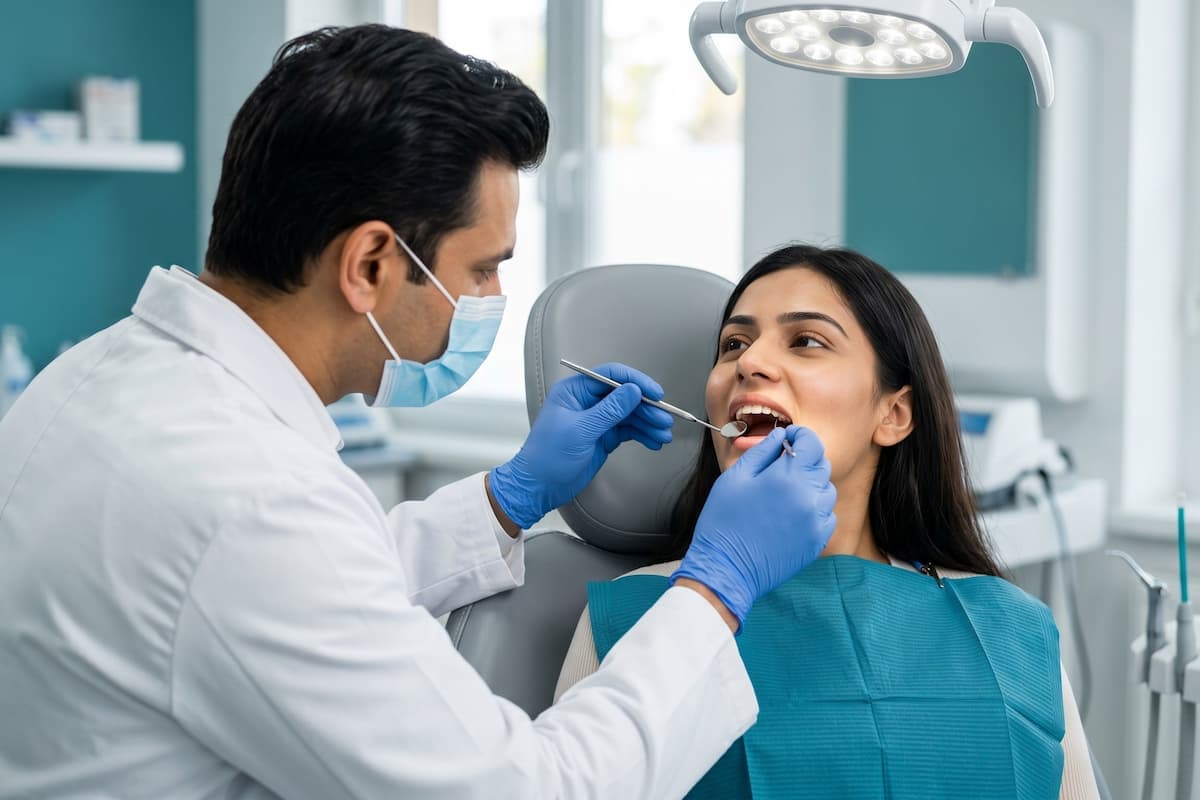
At the end of a crown fitting appointment you are asked to bite on a strip of coloured paper, tap your teeth together, grind side to side, and say whether it feels normal. A little adjustment follows, then the paper again, and so on.
It looks like a formality. It is not. The tolerance the human bite detects is remarkably fine — people reliably notice discrepancies of a few tens of microns, thinner than a sheet of paper — and getting this wrong causes problems out of all proportion to the size of the error.
Why teeth detect such small differences
The periodontal ligament surrounding each natural tooth contains mechanoreceptors that are exquisitely sensitive to pressure. They exist to protect teeth: they detect a hard object and trigger a reflex that stops the jaw closing before damage occurs.
Their sensitivity is the reason you can find a fragment of shell in a mouthful of food, and the reason a crown a fraction too tall feels like a boulder. The feedback is real and it is accurate. When a patient says a new crown feels high, they are almost always correct.
Implants, having no ligament, provide no such feedback — which is why implant crowns are adjusted to a deliberately different scheme. Our article on load distribution in titanium implants covers that difference.
What happens if it is left high
The tooth becomes tender to bite on. The ligament is being overloaded and becomes inflamed, producing exactly the symptom people describe as "it hurts when I chew". Our article on a filling that hurts weeks later covers the same mechanism in a different restoration.
The tooth may become sensitive or ache. Persistent overload can produce pulpal symptoms in a vital tooth, occasionally to the point of requiring root canal treatment.
The tooth can become slightly mobile, as the ligament widens in response to the excess load.
Muscles compensate. The jaw muscles will adapt to avoid the high contact, and sustained muscle activity produces facial ache, temple headaches and morning stiffness. This is a common and often unrecognised cause of new jaw pain after dental treatment. See TMJ treatment and our article on a jaw that feels weak when chewing.
The crown or the opposing tooth can fracture. A single tooth taking a disproportionate share of the load is the tooth that breaks. Ceramic chipping on a new crown frequently traces back to an uncorrected contact.
Other teeth drift. Over months, the bite reorganises around the interference.
What happens if it is left low
Less dramatic, but not harmless.
The opposing tooth over-erupts into the space over months or years, changing the bite.
Load transfers to the neighbouring teeth, which now take the share the crowned tooth is not carrying.
Food packs at the contact points if the relationships are wrong.
The crown does not do its job. A crown placed to protect a weakened tooth needs to be in function.
What the adjustment actually involves
Static contacts first. With the crown seated, you close into your normal bite while articulating paper marks where contact occurs. The dentist is looking for marks on the crown that are the same weight as the marks on your other teeth — not heavier, not absent. A common check is passing a thin shim between the crown and the opposing tooth: it should hold with the same resistance as at adjacent teeth.
Then dynamic movements. You grind side to side and forwards. This is the part people sometimes find odd, and it is essential. A crown can be perfect when you close straight down and still interfere when the jaw moves laterally — and lateral interferences are the ones most associated with muscle pain, tooth fracture and mobility. Ideally the crown should not be carrying the guidance unless it was doing so before.
Different coloured papers are often used to distinguish closing contacts from sliding contacts, which is why you may be asked to bite several times on different colours.
Small, incremental reduction. Material is removed a little at a time, rechecking between each pass. Removing too much cannot be undone.
Your own assessment matters. You are asked how it feels because your ligament receptors are more sensitive than any instrument in the room. If it does not feel right, say so — including if you are not sure.
Local anaesthetic complicates this. If you were numbed for the fitting, your perception of the bite is unreliable, and the adjustment may need rechecking once sensation returns. This is a common reason a crown feels fine at the appointment and high the next day.
Why repolishing matters
This is the step that gets skipped and should not.
Adjusting a glazed ceramic crown removes the glaze and leaves a roughened surface. A roughened ceramic surface is abrasive to the opposing tooth, accumulates plaque more readily, and is weaker — surface flaws are where cracks begin in ceramics.
So any adjusted area must be repolished properly with a graded ceramic polishing sequence, or the crown returned to the laboratory for reglazing. Well-polished ceramic is gentle on opposing enamel; adjusted-and-unpolished ceramic is not. This applies particularly to zirconia — see our article on monolithic zirconia.
The same logic applies to the margins: our article on modern ceramic crowns and gum health covers why surface smoothness matters at the tissue interface too.
Why it sometimes needs rechecking later
Even a well-adjusted crown can need a second look, for legitimate reasons.
Anaesthetic wore off and your perception changed.
The tooth was tender before the crown was cemented, so you were unconsciously avoiding biting fully on it. As it settles, you begin closing properly and the contact becomes apparent.
The jaw muscles were tired after a long appointment and the jaw was not closing in its usual position.
The tooth settles slightly in its ligament over the following days.
Your bite changes over time anyway, as teeth wear and move.
None of this indicates that something went wrong. A short review to check the bite after a new crown is routine, and it is not an imposition to ask for one.
When to get in touch
Contact the practice if, after a new crown:
• It still feels high or as though you hit it first, after a few days
• The tooth is tender to bite on and not improving
• You have developed jaw ache, facial muscle tightness or temple headaches
• Your teeth do not seem to meet the way they used to
• Food is packing at that tooth
• The tooth has become sensitive to cold or is aching spontaneously
• You notice chipping or wear on the crown or the tooth opposite
The last of these matters: a crown that chips within months is usually telling you something about the bite rather than about the ceramic.
Most bite adjustments take a few minutes. Leaving a high crown in place for months does not.
Frequently Asked Questions
Is it normal for a new crown to feel slightly different?
A brief period of awareness is common as the tongue and cheek get used to a new shape. Feeling that you hit that tooth first, or tenderness on chewing, is not, and warrants adjustment.
How long should I wait before reporting a high bite?
A few days of mild awareness is reasonable. Definite tenderness on biting, or the sensation of contacting that tooth first, should be reported promptly rather than waited out.
Can the bite be adjusted after the crown is cemented?
Yes — occlusal adjustment is routinely done after cementation, and the crown does not need removing. The adjusted area should then be repolished.
Why did my dentist ask me to grind side to side?
To check for interferences during jaw movement. These are a frequent cause of muscle pain and tooth fracture and are missed if only the closed position is checked.
Could a high crown cause headaches?
Sustained muscle activity from compensating for an interference can produce facial ache and temple headaches. It is a recognised and readily correctable cause.
Will adjusting the crown weaken it?
Removing a small amount of material and repolishing properly does not. Leaving it unpolished does weaken the surface, which is why repolishing is part of the procedure.
Next Steps
If a crown still feels high, or a tooth has been tender to bite on since a restoration was fitted, a short bite check is usually all that is needed — and it is worth doing sooner rather than later.
You can contact our team at our Wimpole Street practice, or see our dental crowns page.
Dental Disclaimer
This article provides general information about occlusal adjustment and does not constitute individual dental advice. Bite-related symptoms can have several causes and require clinical examination. Wimpole Dental is regulated by the Care Quality Commission, and our clinicians are registered with the General Dental Council.
Next review due: 14 September 2027
Written by Dr Elisabeth Lichtmannegger · reviewed by Dr Elisabeth Lichtmannegger, GDC 319325
This article is general information, not personal clinical advice. For a diagnosis and a plan tailored to you, book a consultation with a GDC-registered dentist.
Related treatments at our Wimpole Street practice