Porcelain Veneers for Discoloured Teeth: What Causes Staining and When Veneers Are Appropriate

Veneers are frequently presented as the answer to discoloured teeth, and for some kinds of discolouration they are. For others they are an unnecessarily invasive response to something that would have resolved with whitening, and for a small number of cases they will not achieve what the patient is hoping for at all.
Getting this right starts with identifying what kind of discolouration you have, because that determines everything else.
Extrinsic staining — on the surface
Pigment adhering to the outside of the enamel, within the acquired film that forms on teeth.
Causes: tea, coffee, red wine, dark fruits and sauces, tobacco, some mouthwashes — chlorhexidine in particular — and iron supplements.
How it behaves: it builds up gradually, sits more heavily near the gum line and in grooves, and is worse where cleaning is less thorough.
What treats it: professional cleaning, air-polishing, and improved daily cleaning. Our article on airflow stain removal compared with whitening covers the distinction, and how coffee stains teeth covers prevention.
Veneers are not indicated for this alone. If the discolouration lifts with a cleaning appointment, it did not need a restoration.
Intrinsic discolouration — within the tooth
Colour within the enamel and dentine themselves.
Ageing. Dentine thickens over a lifetime and enamel thins, so more of the yellower dentine shows through. Extremely common, entirely normal, and generally the most whitening-responsive type.
Tetracycline staining. Antibiotics taken during tooth formation incorporate into the developing tooth, producing grey, brown or blue-grey banding across the teeth. Distinctively horizontal in pattern. Mild cases improve with prolonged whitening; severe banded cases generally do not respond adequately.
Fluorosis. Excess fluoride during development, producing white flecks and patches in mild cases and brown mottling with surface pitting in severe ones. Mild fluorosis often responds well to a combination of whitening and microabrasion.
Trauma. A tooth that has been knocked can darken over months or years — grey, brown or pink — as the pulp reacts or dies. Usually a single tooth, which makes it conspicuous.
A non-vital or root-treated tooth. Breakdown products from the pulp stain the dentine from within. Often the darkest discolouration, and confined to one tooth. Internal whitening from inside the tooth is frequently effective here and should generally be tried before considering a veneer.
Enamel developmental conditions such as amelogenesis and dentinogenesis imperfecta, where the tooth structure itself is abnormal.
Old restorations. An amalgam filling can leave a grey shadow through the tooth; an old composite can discolour and take the surrounding tooth with it. Replacing the restoration may be the whole answer.
Decay, which can appear as brown or dark discolouration and needs treating on its own terms rather than covering.
Age-related, combined
Most middle-aged patients have a combination: thinning enamel, thickening dentine, accumulated surface stain, worn edges revealing dentine, and a few old restorations that no longer match.
This combination often responds very well to whitening plus hygienist treatment plus replacement of one or two visible fillings — at a fraction of the cost and biological expense of veneers.
The order to work through
A reasonable sequence, and the one most likely to keep the treatment proportionate:
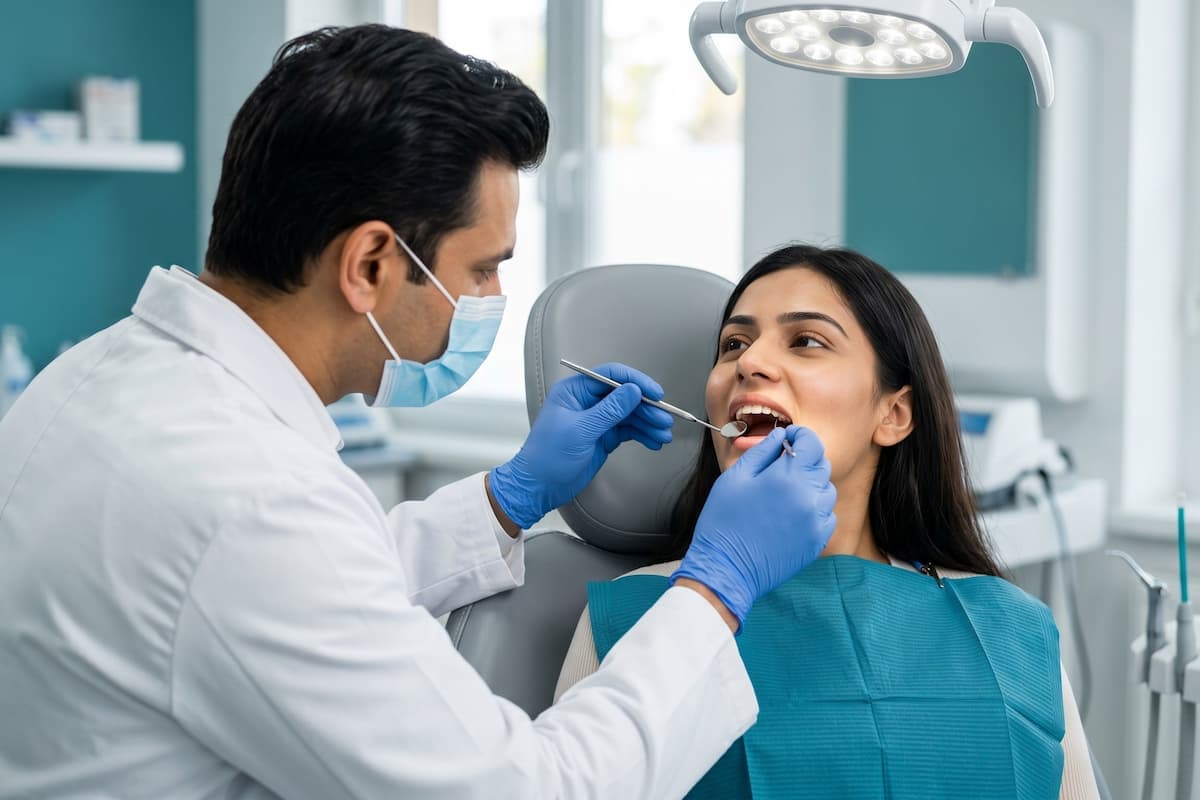
1. Establish the cause. Examination and radiographs. A single dark tooth needs its vitality assessed. Decay needs excluding. This is not optional — placing veneers over undiagnosed decay or an infected tooth stores up a much larger problem.
2. Professional cleaning. Removes the extrinsic component and reveals the actual underlying colour, which is frequently better than expected.
3. Whitening. Safe, non-destructive and reversible in the sense that it removes no tooth structure. It is the appropriate first-line treatment for most generalised discolouration, and it should be completed and allowed to stabilise before any decision about restorations. See our teeth whitening page.
4. Internal whitening for a single dark non-vital tooth, where indicated.
5. Microabrasion for superficial white or brown surface defects, which removes a very thin layer of enamel and can resolve mild fluorosis and some white marks.
6. Replace discoloured restorations, which sometimes resolves the whole concern.
7. Composite bonding, which can mask discolouration with little or no tooth removal and is repairable and reversible. Our articles on whether bonding can hide a dark non-vital tooth and composite veneers for minor corrections cover the option.
8. Porcelain veneers, where the preceding options will not achieve the result.
When veneers are genuinely the right answer
Severe tetracycline banding, particularly the grey-blue variety, which does not respond adequately to whitening even over extended periods.
Severe fluorosis with pitting and brown mottling, where the surface texture is affected as well as the colour.
A single dark tooth that has not responded to internal whitening, or where internal whitening is not possible.
Discolouration combined with other concerns — worn or chipped edges, an irregular shape, spacing, minor rotations. Where the tooth needs reshaping as well as re-colouring, a veneer addresses both.
Enamel developmental conditions, where the enamel itself is structurally abnormal and whitening cannot produce a uniform result.
Teeth with extensive existing restorations on the front surface, where so much of the visible tooth is already filling material that whitening would produce a patchwork.
Where whitening has been tried properly and the result is not acceptable — which is a legitimate reason, provided the trial was genuine.
When veneers are not the right answer
Surface stain that cleaning removes.
Generalised yellowing that would respond to whitening. This is the most common unnecessary use of veneers.
Untreated decay or gum disease. These are treated first, always.
A tooth with an untreated infection. Placing a veneer over it does not address it.
Teeth with very little enamel remaining, where there is nothing sound to bond to. Bond strength to dentine is lower than to enamel, and veneers bonded largely to dentine are less predictable. Our article on chemical bond strength in modern porcelain veneers covers the adhesive requirement.
Unmanaged grinding, until it is addressed.
Unrealistic expectations — particularly the expectation of a uniform, very high-value result that will look natural. Our article on whether veneers are worth it is worth reading first.
The masking problem
If veneers are the chosen route for a dark tooth, there is a technical constraint worth understanding at the planning stage.
Porcelain veneers are thin and at least partly translucent. Light passes through them and picks up the colour of whatever is underneath. A very dark substrate shows through a thin translucent veneer.
Masking it requires some combination of:
More opacity in the ceramic, which reduces the depth and vitality of the result — the trade-off being a veneer that hides the darkness but looks flatter.
More thickness, which means removing more tooth, sometimes taking the preparation beyond enamel into dentine.
An opaque cement or a masking layer beneath the veneer.
Lightening the underlying tooth first — internal whitening for a non-vital tooth, or external whitening — which is the most conservative solution and is why it appears earlier in the sequence above.
Our articles on whether veneers can hide dark discoloured teeth and the optical properties of dental ceramics cover the physics behind this.
Single-tooth cases are the most demanding of all, because the result has to match an untouched natural neighbour millimetres away. Our article on matching a single veneer to the rest of a smile covers what is involved.
What to expect if you proceed
A written plan setting out how many veneers, how much preparation, what the shade will be and what preparatory treatment is needed.
A wax-up and trial smile, so the proposed result is seen before teeth are prepared.
Shade decisions made after whitening has stabilised, since the veneers cannot be lightened afterwards.
Provisional veneers while the definitive ones are made.
A try-in with the veneers held in place with try-in paste, viewed in daylight, before final bonding.
Commitment. Where a tooth has been prepared, it will need a restoration for the rest of its life. This is the reason for working through the conservative options first.
Our article on what influences the cost of porcelain veneers covers the stages in the context of the fee.
Frequently Asked Questions
Will whitening work on my discoloured teeth?
It depends on the type. Age-related yellowing and mild intrinsic discolouration usually respond well; severe tetracycline banding and structural enamel conditions generally do not.
Can one dark tooth be lightened without a veneer?
Frequently yes. Internal whitening of a non-vital tooth is often effective and removes no tooth structure.
Do veneers cover any level of discolouration?
They can mask a great deal, but very dark substrates require more opacity or more thickness, and both involve a trade-off in appearance or tooth removal.
Can I have veneers on just the front two teeth?
Yes, though matching to the untouched neighbours is the most demanding scenario and requires careful shade work.
Will the veneers stain in the same way my teeth did?
Glazed porcelain resists stain and does not absorb pigment. The margins and surrounding natural teeth can still discolour — see our article on porcelain veneer resistance to staining.
Should I whiten before or after veneers?
Before. Porcelain does not respond to whitening agents, so the shade of the surrounding teeth must be settled first.
Next Steps
If discoloured teeth are the concern, the most useful first step is an assessment that identifies what kind of discolouration it is — because that frequently opens up options considerably more conservative than veneers.
You can contact our team at our Wimpole Street practice, or see our porcelain veneers and teeth whitening pages.
Dental Disclaimer
This article provides general information about tooth discolouration and veneers, and does not constitute individual dental advice. The cause of discolouration and the appropriate treatment are determined through clinical examination and radiographs. Wimpole Dental is regulated by the Care Quality Commission, and our clinicians are registered with the General Dental Council.
Next review due: 15 September 2027
Written by Dr Elisabeth Lichtmannegger · reviewed by Dr Elisabeth Lichtmannegger, GDC 319325
This article is general information, not personal clinical advice. For a diagnosis and a plan tailored to you, book a consultation with a GDC-registered dentist.
Related treatments at our Wimpole Street practice