How Early Detection of Gum Disease Reduces Long-Term Costs

Gum disease is unusual among common conditions in how sharply the treatment burden escalates with delay. At the earliest stage it is fully reversible with cleaning and a change in daily habits. Once bone has been lost, it is not reversible at all — it can be stabilised, but the support that has gone does not come back.
Between those two points sits a divergence that is both clinical and financial. This article explains where the thresholds are, why the condition is so easily missed, and what early detection actually involves.
Why it goes unnoticed
Periodontitis is, for most of its course, silent.
It does not hurt. Unlike decay, which eventually produces sensitivity and pain, periodontal disease is typically comfortable until it is advanced. The absence of pain is not reassuring; it is the central problem.
It looks normal. Gums can appear reasonably healthy while significant attachment loss has occurred beneath them. This is particularly true in smokers, where nicotine constricts blood vessels and suppresses the bleeding that would otherwise be the warning sign.
It progresses slowly. Bone loss typically occurs over years, sometimes in episodic bursts. There is no moment at which it becomes obvious.
Bleeding is normalised. A great many people believe that gums bleeding when brushing is normal. It is not — it is the most common early sign. Our article on bleeding gums when brushing covers what it indicates.
It is measured, not seen. The diagnosis depends on probing depths, attachment levels and radiographic bone height. None of these can be assessed by looking in a mirror.
Healthy
No bleeding on probing, probing depths of three millimetres or less, no attachment or bone loss.
Requires: routine hygiene maintenance at a risk-appropriate interval, and effective daily cleaning.
Gingivitis
Inflammation confined to the gum. Bleeding on probing, redness, possible swelling. No attachment or bone loss.
Fully reversible. Thorough professional cleaning plus effective daily plaque control, particularly interdental cleaning, resolves it within weeks. The tissue returns to normal and nothing is permanently lost.
Requires: one or two hygiene appointments, proper oral hygiene instruction, and a follow-up to confirm resolution.
Early periodontitis
Attachment loss has begun. Probing depths of four to five millimetres, bleeding on probing, early bone loss visible radiographically.
Not reversible, but readily stabilised. Non-surgical periodontal therapy — thorough removal of deposits from root surfaces beneath the gum — arrests progression in the large majority of cases at this stage.
Requires: a course of non-surgical therapy, typically over two to four appointments, a re-evaluation after eight to twelve weeks, and ongoing maintenance at a shortened interval, usually three-monthly.
Moderate periodontitis
Probing depths of six millimetres or more in places, definite bone loss, possibly some mobility, possibly recession and sensitivity.
Requires: more extensive non-surgical therapy, often with local anaesthetic, sometimes with adjunctive antimicrobials, re-evaluation, and in sites that do not respond, periodontal surgery to access deeper deposits and reshape defects. Referral to a periodontist is common at this stage. Lifelong three-monthly maintenance is needed thereafter.
Advanced periodontitis
Severe bone loss, deep pockets, mobility, drifting teeth, recession, sometimes abscesses, and tooth loss.
Requires: comprehensive periodontal therapy, often surgical, possibly regenerative procedures, extraction of teeth beyond saving, and then replacement of those teeth — implants, bridges or dentures — each of which carries its own ongoing maintenance burden. Splinting of mobile teeth. Management of the aesthetic consequences of recession and drifting.
And implants placed in a patient with a history of periodontitis carry a higher risk of peri-implant disease, which means the problem does not end with replacement.
Our article on the difference between gingivitis and periodontitis covers the distinction in more detail, and our article on whether gum disease can be reversed sets out what is achievable at each stage.
The economics
Without quoting figures, the pattern is straightforward and worth stating explicitly.
Gingivitis is resolved with a small number of routine appointments and costs little beyond ordinary preventive care. Early periodontitis requires a defined course of treatment plus more frequent ongoing maintenance — a real but contained increase. Moderate periodontitis adds surgical procedures and referral for further care. Advanced periodontitis adds extraction, replacement of teeth, and the lifelong maintenance of whatever replaces them.
The escalation between those stages is not linear. Replacing a single tooth with an implant costs a substantial multiple of a course of periodontal therapy, and an implant is not a permanent fixture requiring no further attention — it requires more maintenance than the tooth it replaced.
There is also an indirect cost: time. Emergency appointments, multiple treatment visits, surgical recovery, and the disruption these cause.
Our article on the cost benefits of regular hygiene visits compared with emergency care covers this comparison in more detail, and our article on whether a dental maintenance plan is worth it looks at the ongoing side.
What early detection actually involves
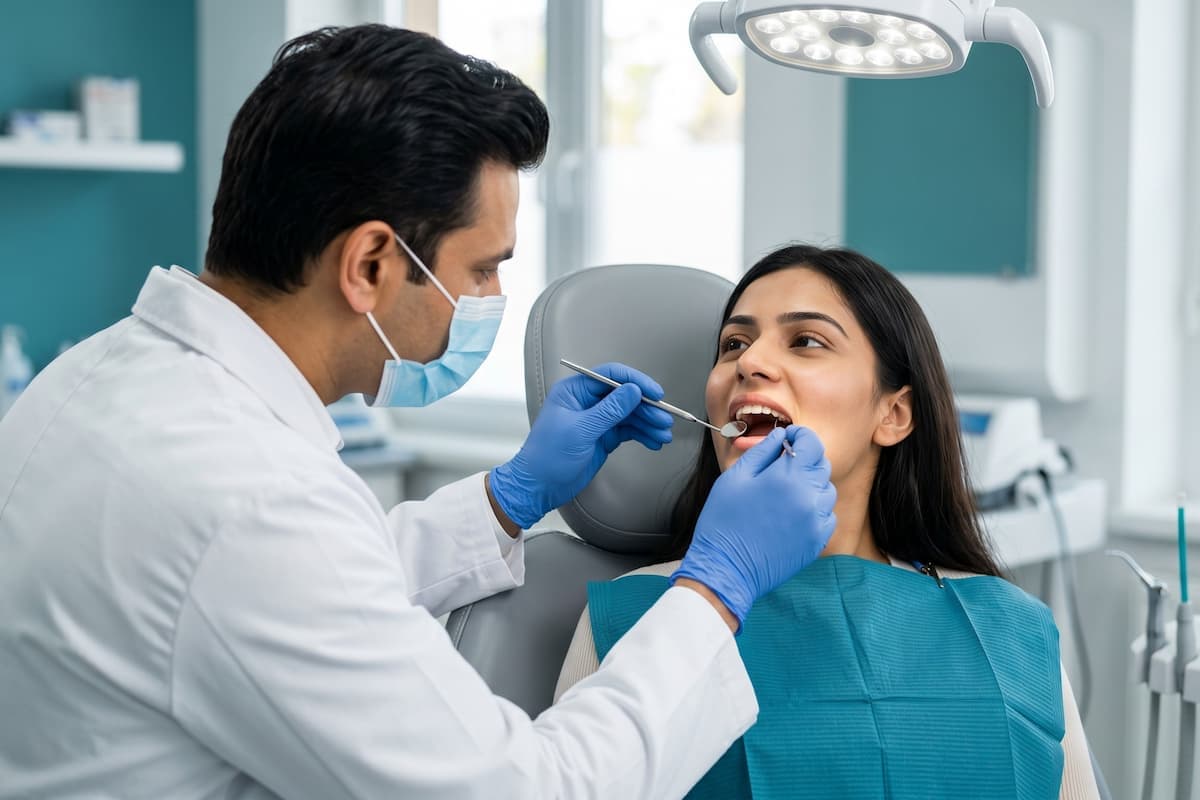
Basic periodontal examination. A screening carried out at check-up appointments in which the mouth is divided into six sextants and a score recorded for each based on probing depths and bleeding. It takes a few minutes and identifies who needs a full assessment.
Full periodontal charting. Where screening indicates it, six measurements are recorded around every tooth, along with bleeding, recession, furcation involvement and mobility. This is the diagnostic record against which future change is measured.
Radiographs. Bitewings or periapical films to assess bone levels. These establish a baseline and reveal loss that probing alone may underestimate.
Risk assessment. Smoking status, diabetes, family history, previous periodontal treatment, medications, stress and plaque control. These determine how closely you need to be monitored. Our article on the impact of chronic stress on gum health covers one of the less obvious factors.
A recall interval set on that basis rather than on a default six months.
Our article on how often to see a hygienist explains how intervals are determined, and our article on what a hygiene appointment involves covers the appointment itself.
The signs worth acting on
• Bleeding when brushing or cleaning between teeth — the most common early sign, and the most commonly dismissed
• Persistent bad breath or a bad taste. Our article on halitosis and gum problems covers the assessment
• Gums that look red, swollen or shiny rather than firm and pale pink
• Teeth appearing longer as the gum recedes
• Increasing gaps between teeth, or food trapping in new places
• Teeth that feel loose or have moved position
• A change in how your teeth meet when biting
• Sensitivity at the gum line from exposed root surfaces
• Any discharge from the gum margin
Several of these appear late. The first one appears early, which is why it deserves more attention than it usually receives.
Who is at higher risk
Smokers, for whom risk is substantially elevated and the warning signs are suppressed.
People with diabetes, particularly where control is poor. The relationship is bidirectional. Our article on how oral health impacts total body wellness covers the evidence.
Those with a family history, since susceptibility has a genetic component.
People under sustained stress, which affects both immune function and self-care.
Those with crowding or restorations that are difficult to clean.
People taking medications causing dry mouth or gingival overgrowth.
Anyone who has previously had periodontal treatment, since the condition recurs without maintenance.
Frequently Asked Questions
How do I know if I have gum disease?
You generally cannot know without an examination, because the condition is measured rather than seen and produces no discomfort until late. Bleeding when brushing is the most useful sign you can observe yourself, and it warrants an assessment.
Is bleeding when I brush normal?
No. Healthy gums do not bleed when cleaned. Bleeding indicates inflammation, which at the gingivitis stage is fully reversible with thorough cleaning. Persisting beyond two weeks of improved cleaning, it needs assessment.
Can gum disease be reversed?
Gingivitis resolves completely. Periodontitis, where attachment and bone have been lost, can be stabilised and its progression halted, but lost support is not reliably regained. That threshold is the reason early detection matters so much.
How often should I be screened?
A basic periodontal examination should be carried out at routine check-ups. How often those occur depends on your risk — anywhere from three-monthly to annually. If you have never had probing depths recorded, ask.
Does gum disease always lead to tooth loss?
No. Detected and treated at the early stages, and maintained thereafter, the large majority of cases are stabilised and teeth are retained. Tooth loss is the outcome of untreated or poorly maintained disease.
Will I need to be referred elsewhere?
Many cases are managed within general practice by the dentist and hygienist. More advanced cases, or those not responding to initial therapy, are commonly referred to a periodontist for further treatment.
Why do I need to come every three months?
Because after periodontal treatment, the bacteria responsible repopulate the pockets over roughly that period. Three-monthly maintenance interrupts that cycle. It reflects the biology of the condition rather than a commercial preference.
Next Steps
If it has been some time since anyone measured your gums — as opposed to looking at them — that is worth arranging. A basic periodontal examination takes a few minutes and identifies whether anything further is needed.
If your gums bleed when you brush or clean between your teeth, do not wait for the next routine appointment. That is the stage at which the condition is fully reversible, and it does not remain there indefinitely.
You can contact our team to arrange an appointment at our Wimpole Street practice. Our gum disease treatment and dental hygiene pages explain what is involved.
Dental Disclaimer
This article provides general information and does not constitute individual dental advice. Your periodontal status, the treatment required and the appropriate recall interval can only be determined following clinical examination and, where indicated, radiographs. Treatment outcomes vary between individuals and depend on factors including plaque control, smoking status and general health. Wimpole Dental is regulated by the Care Quality Commission, and our clinicians are registered with the General Dental Council.
Next review due: 10 September 2027
Written by Dr Elisabeth Lichtmannegger · reviewed by Dr Elisabeth Lichtmannegger, GDC 319325
This article is general information, not personal clinical advice. For a diagnosis and a plan tailored to you, book a consultation with a GDC-registered dentist.
Related treatments at our Wimpole Street practice